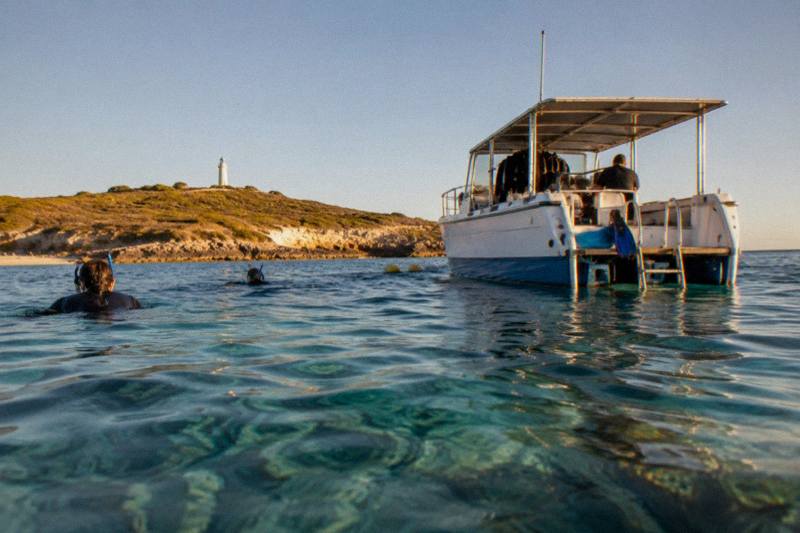
Rottnest Island Snorkelling Tours And Spots
Rottnest Island sits in the path of the warm Leeuwin Current, and the result is 135-plus species of tropical fish swimming in water that stays warm through summer. Here is where to get in, and which tours do the work for you.
Short answer
The two marked snorkel trails sit inside the Parker Point marine sanctuary, a 17-minute bike ride from Thomson Bay and stop 5 on the Island Explorer bus. A guided boat trip runs from A$239, a half-day catamaran snorkel and sail from A$185, and a DIY ferry and bike day from Hillarys from A$124 per person.
Rottnest Island, known to the Whadjuk Noongar people as Wadjemup, is a place where tropical fish gather in real numbers. The Leeuwin Current sweeps warm water down the coast, holding sea temperatures near 23 degrees through summer, and more than 135 species of tropical fish have been recorded around the island's 63 beaches and 20 bays. Five of those bays are protected marine sanctuary zones where fishing and collecting are banned outright, which is precisely why the snorkelling is so good. Some visitors bring their own mask and ride a hire bike between coves; others let a boat do the travelling and a guide do the finding. This guide covers both, with verified prices for every tour and the safety rules that matter before you get wet.
Where Are The Best Snorkel Spots On Rottnest Island?
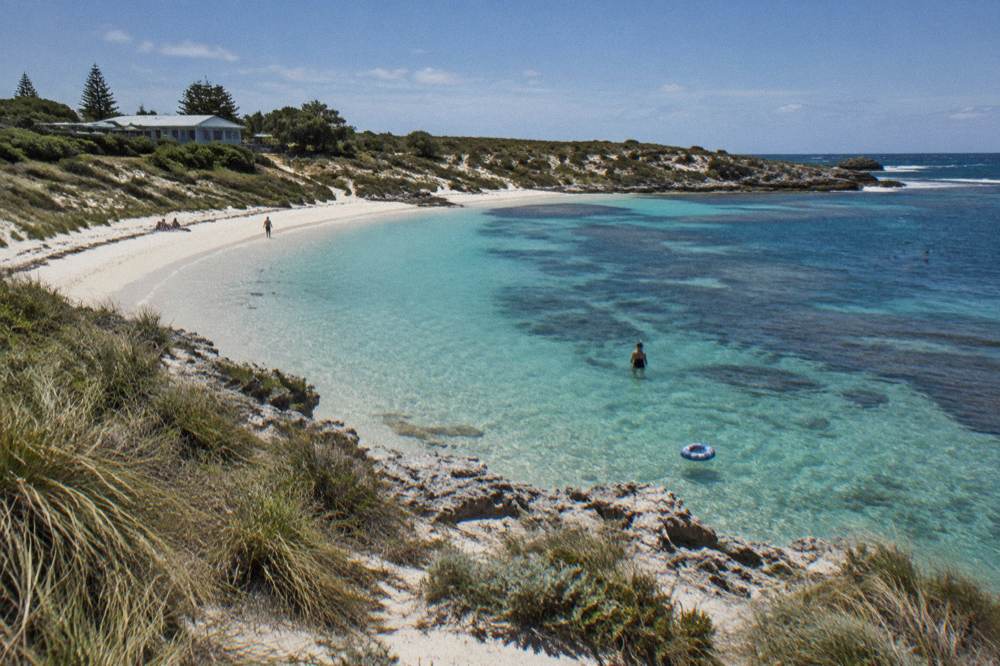
The best snorkelling on Rottnest Island sits on the sheltered southern and eastern shore: Parker Point and Little Salmon Bay inside the Parker Point marine sanctuary zone, plus the calm shallows of The Basin, Little Salmon Bay and Green Island. The marked trails at Parker Point and Little Salmon Bay are the island's signature sites, both reached by bike in under half an hour from the Thomson Bay settlement. West End offers bigger scenery but exposed conditions.
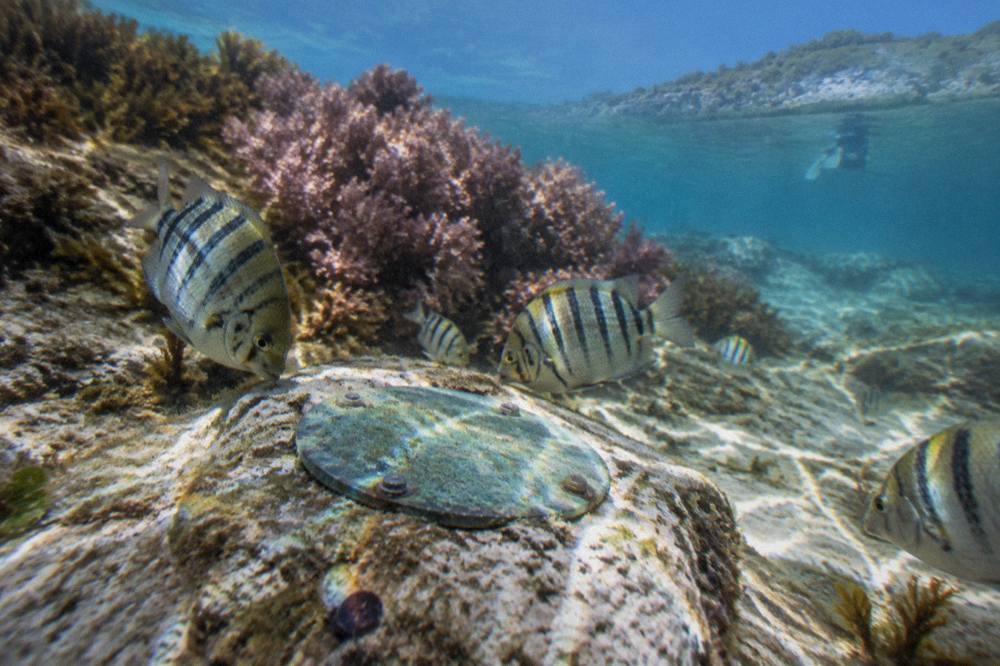
Shelter matters more than scenery here. The prevailing south-westerly swell pushes into the western bays, while Parker Point and Little Salmon Bay, on the protected south-east corner, stay swimmable on most days. The official Parker Point Snorkel Trail page describes a chain of 12 interpretive plaques bolted to the seabed, each one introducing the reef life around it. Little Salmon Bay carries a second marked trail with 10 buoys floating above plaques. Neither is deep: both trails sit close enough to the surface that freediving down to read a plaque is a matter of a few kicks.
The Basin, a short walk from the main settlement, is the family pick. It is a nearly enclosed lagoon with a sandy floor and gentle depth, useful for anyone whose snorkelling career is one afternoon old. Green Island, off the eastern shore, is a small granitic island with a seal habitat in its sanctuary zone; the water between the island and the beach is shallow and clear. Further afield, West End and Cathedral Rocks reward confident snorkellers on calm days, and the Cathedral Rocks platform is the place to watch long-nosed fur seals hauling out, though swimming with the seals is not permitted. For a broader picture of the island's bays, see the Rottnest Island map guide.
| Spot | Where | Shelter | Best for |
|---|---|---|---|
| Parker Point trail | South-east, stop 5 on the bus | Good | Marked trail, plaques, reef fish |
| Little Salmon Bay trail | South coast, next stop past Parker Point | Good | Second marked trail, quieter |
| The Basin | Walk from Thomson Bay | Very good | Beginners, families |
| Green Island | Eastern shore | Fair | Shallow reef, bird life |
| West End | Western tip | Poor in swell | Confident snorkellers, big scenery |
What Is The Parker Point Snorkel Trail?
The Parker Point Snorkel Trail is a marked snorkel route of 12 interpretive plaques fixed to the seabed inside the Parker Point Marine Sanctuary Zone, a 17-minute bike ride from Thomson Bay and next to stop 5 on the Island Explorer bus. Each plaque explains part of the reef community around it, and no fishing or collecting is allowed anywhere in the zone. The trail is the island's most accessible serious snorkel.
The plaques are the point of difference. Rather than floating hopefully over reef, you follow a defined route and read the seabed as you go: coral formations, grazing fish, the invertebrate life of the limestone reef. The zone protects a pink coral reef, one of the reasons the park authorities closed it to fishing and collecting. Visibility is usually at its best in the morning before the afternoon breeze ripples the surface, which pairs neatly with the fact that quokkas, the island's other famous residents, are also most active early. More on their habits sits in the quokkas on Rottnest Island guide.
Getting there without a bike is easy. The Island Explorer hop-on hop-off bus runs roughly every 15 minutes and stops at Parker Point; the free daily walking tours run by the Rottnest Voluntary Guides are a separate, land-based option. If you are riding, the official cycle-path network covers 22 km and helmets are required by law. Most people combine the trail with a loop past Little Salmon Bay, one bay further west, where the second marked trail waits. Both trails sit in sanctuary water, so leave the fishing rod behind entirely on that side of the island.
Season shapes the experience. The sea holds near 23 degrees through summer thanks to the Leeuwin Current and cools to about 18 degrees across winter, so a short wetsuit extends comfort in the cooler months. Seasonal snorkel tour operators reopen in spring after their winter pause, and the warmer months bring the biggest fish activity. None of that requires a tour: plenty of visitors do this trail on a DIY Rottnest Island ferry and bike package, which bundles the crossing, admission and a bike in one fare.
The question then becomes whether you want a guide, a boat and supplied gear, or your own mask and a hire bike. These three listings cover the spread:
Should You Snorkel Self-Guided Or Take A Guided Tour?
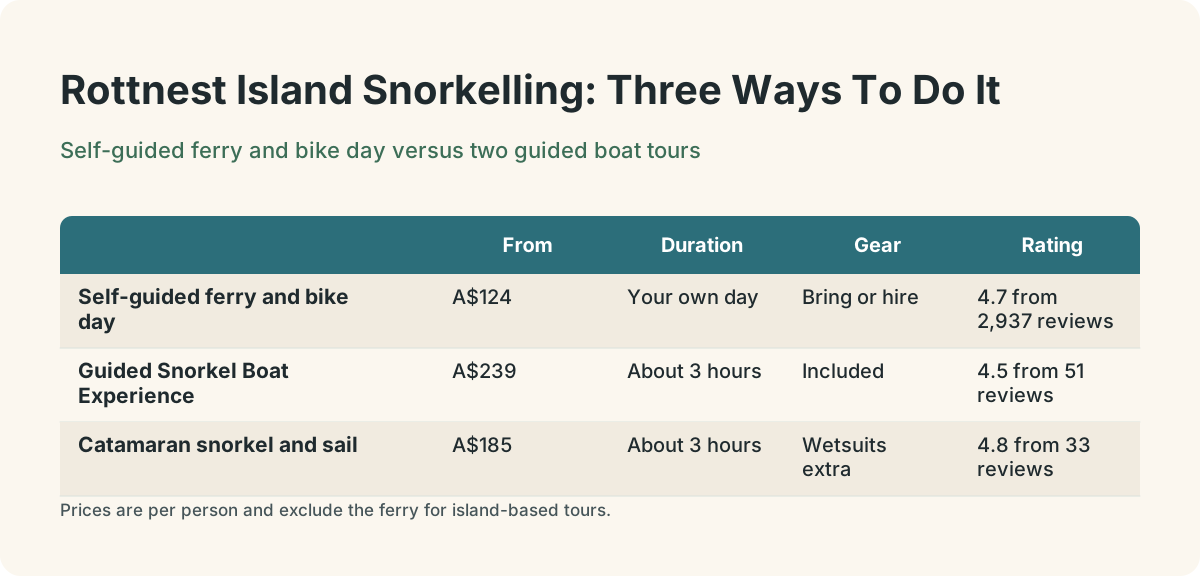
Self-guided snorkelling suits confident swimmers who want freedom and a low spend: a ferry and bike day from Hillarys starts at A$124 per person with gear arranged yourself. A guided boat tour, from A$185 for a catamaran trip or A$239 for a guided snorkel boat experience, adds supplied equipment, a crew who read the conditions, and access to spots a cyclist cannot reach. Both are legitimate choices.
The honest trade-off is control against convenience. Doing it yourself means choosing your own bays, spending as long as you like at each plaque, and paying nothing beyond the ferry and bike package. It also means carrying or hiring a mask, fins and a wetsuit, checking conditions yourself, and accepting that the best water may be a long ride from your towel. Guided trips move the effort to the crew: the Rottnest Snorkel guided boat experience includes equipment, water, coffee, tea and fruit platters plus landing and facility fees in its A$239 fare, runs about three hours, and carries a 4.5 rating from 51 reviews. The half-day catamaran option from Charter 1, from A$185, scores 4.8 from a small pool of 33 reviews, and adds kayaks and stand-up paddleboards alongside the snorkelling, though ferry transfers to the island are not included in either island-based trip.
| Self-guided | Guided boat trip | Catamaran snorkel and sail | |
|---|---|---|---|
| From | A$124 (ferry and bike, Hillarys) | A$239 | A$185 |
| Duration | Your own day | About 3 hours | About 3 hours |
| Gear | Bring or hire separately | Included | Included, wetsuits not included |
| Departs | Hillarys | On the island | On the island |
| Best for | Independence, budget | Fish finding, tuition | Comfort, extras like kayaks |
| Cancellation | Free cancellation | Free cancellation | Per the listing |
Families and weaker swimmers should lean guided, and not only for the gear. Crew on the boat trips point out fish, keep count of everyone in the water, and pick the calmest available site that morning rather than the one you committed to the night before. Strong swimmers who enjoy their own company will find the self-guided route cheaper and just as rewarding, provided they follow the safety basics covered below. If you want the full decision picture across every island activity, the things to do on Rottnest Island guide lays out the alternatives, and the Rottnest Island snorkelling options compared with the segway and bus tours shows how a water day mixes with a land day.
Which Snorkel Tours Operate From The Island?
Two island-based snorkel tours dominate the roster: the Guided Snorkel Boat Experience by Rottnest Snorkel at A$239 per person, rated 4.5 from 51 reviews, and Charter 1's half-day snorkel and sail catamaran at A$185 per person, rated 4.8 from a small pool of 33 reviews. Both depart from Thomson Bay, both run around three hours, and neither includes the ferry to the island.
The guided snorkel boat trip is the working option: a purpose-built trip with equipment, a restroom on board, hot drinks and fruit, and landing fees bundled in. At A$239 it is the more expensive of the pair, and the 4.5 from 51 reviews gives it the larger review pool. Free cancellation applies on the listing, which matters when sea conditions decide your week. It suits visitors who want a straight answer to "where are the fish today".
The catamaran trip is the more leisurely machine. Charter 1's vessel carries kayaks and paddleboards as well as snorkel gear, serves a seasonal fruit platter, and includes the option of a guided snorkel for confident unaided swimmers. Its 4.8 rating comes from only 33 reviews, a small pool worth naming as one, and its cancellation terms sit in the listing rather than being free. What you buy is a half-day on the water rather than a commute to a dive site, with the sailing itself part of the appeal.
A third route suits snorkellers who also want the island's land life. The ferry and bike day from Hillarys, run by Rottnest Fast Ferries, costs from A$124 per person, includes the return ferry, an all-day bike with helmet and lock, the island admission fee and even courtesy hotel pickup from selected Perth and Scarborough hotels on request. It carries a 4.7 rating from a substantial 2,937 reviews, the biggest review pool on the whole site roster. You supply the mask; the island supplies the reef.
How Do You Get To The Island For A Snorkel Day?
Three ferry operators run the crossing: Rottnest Express and SeaLink from Fremantle and Perth, and Rottnest Fast Ferries from Hillarys, taking about 25 minutes from Fremantle, 45 from Hillarys and up to 90 from Perth. Same-day return adult fares including the A$21.50 admission run from A$87.50 from Fremantle and A$95 from Hillarys, with dynamic pricing on SeaLink.
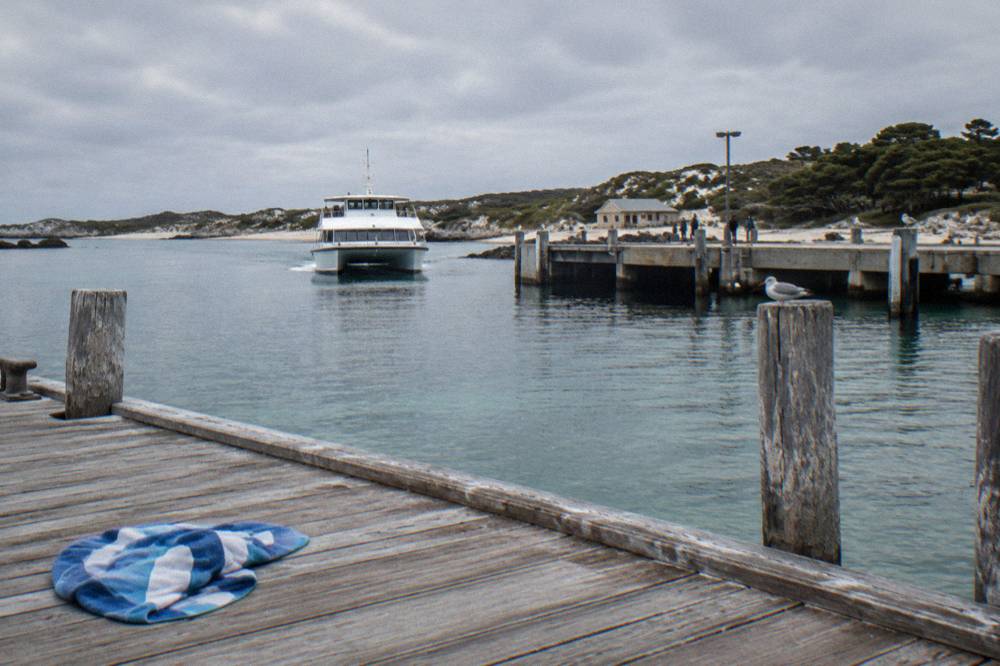
The ferry choice is really a departure-point choice. Fremantle is the fastest and cheapest crossing; Hillarys, north of the city, suits visitors staying in Scarborough or Joondalup and includes free parking at the harbour; Perth's Barrack Street Jetty turns the crossing into a river-and-sea journey of up to 90 minutes. Package fares stack the pieces: the SeaLink ferry and admission listing from Fremantle starts at A$90 per person with a 4.7 rating from 580 reviews, a bare-bones ticket that leaves your day entirely your own. Every fare already contains the Rottnest Island Authority admission, A$21.50 for an adult on a single day, collected by the operators on the authority's behalf, so there is no extra gate fee to budget for.
Bringing your own bike adds freight: A$20 for a pedal bike and A$25 for an e-bike on SeaLink, pre-booked with size limits, and no tandems carried. Hiring on the island through Pedal and Flipper runs A$35 a day for a standard multi-geared bike plus a A$50 deposit, or A$83 plus a A$200 deposit for an electric bike, riders 18 and over only. Many snorkellers skip both by booking a ferry and bike bundle, which is why the Hillarys full-day package at A$124 is the DIY standard. The full fare breakdown lives in the Rottnest Island ferry prices guide, and timetable behaviour is covered in do I need to book the Rottnest ferry in advance.
| Departure point | Operator | Crossing | Same-day adult return incl. admission |
|---|---|---|---|
| Fremantle | Rottnest Express | About 25 min | A$87.50 |
| Fremantle | SeaLink | About 25 min | From A$90 |
| Hillarys | Rottnest Fast Ferries | About 45 min | A$95 |
| Perth (Barrack Street) | Rottnest Express | Up to 90 min | A$135.50 |
| Perth (Barrack Street) | SeaLink | Up to 90 min | From A$134.50 |
What Are The Snorkelling Safety Rules On Rottnest?
Rottnest beaches are not patrolled by lifeguards, so every swim is your own risk assessment: swim with a friend, check conditions before entering, never swim between the main ferry jetty and the Fuel Jetty or near moorings, treat blue bottle jellyfish with respect, and remember venomous dugites live on land. The five marine sanctuary zones ban all fishing and collecting. Children and weak swimmers need active supervision.
The no-lifeguard point comes straight from the Rottnest Island Authority's own excursion guidance, and it changes how you should plan the day. Choose the sheltered bays, enter where you can stand, and keep a buddy in the water rather than a watcher on the sand. Conditions shift with the breeze, and a bay that was glass at breakfast can be choppy by two in the afternoon. The official practical tips page advises against swimming after meals, under the influence of alcohol, or near moorings, jetties and anchorage areas, and names the stretch between the main jetty and the Fuel Jetty as off-limits.
Blue bottle jellyfish can be present at any time of year and do wash up on the sand; their sting is painful but not life-threatening, and the rule is simply not to touch them, in the water or out. On land, dugites are present and timid but will bite if harassed, so give any snake a wide berth and seek medical help immediately if bitten. Seals at Cathedral Rocks are watched from a purpose-built platform precisely because swimming with them is not permitted, however friendly they look. Carry at least two litres of water per person, three in hot weather, since refill points are marked but spread out. Anyone wanting the full wildlife rulebook, including the A$10,000 penalty scale for touching or feeding animals, will find it in why can't you touch a quokka.
What Fish And Marine Life Will You See?
More than 135 species of tropical fish have been recorded around Rottnest Island, drawn by the warm Leeuwin Current, alongside long-nosed fur seals at Cathedral Rocks, ospreys nesting on rocky stacks, and humpback and southern right whales passing between August and December. The five marine sanctuary zones concentrate the reef life, which is exactly why the marked trails sit inside them.
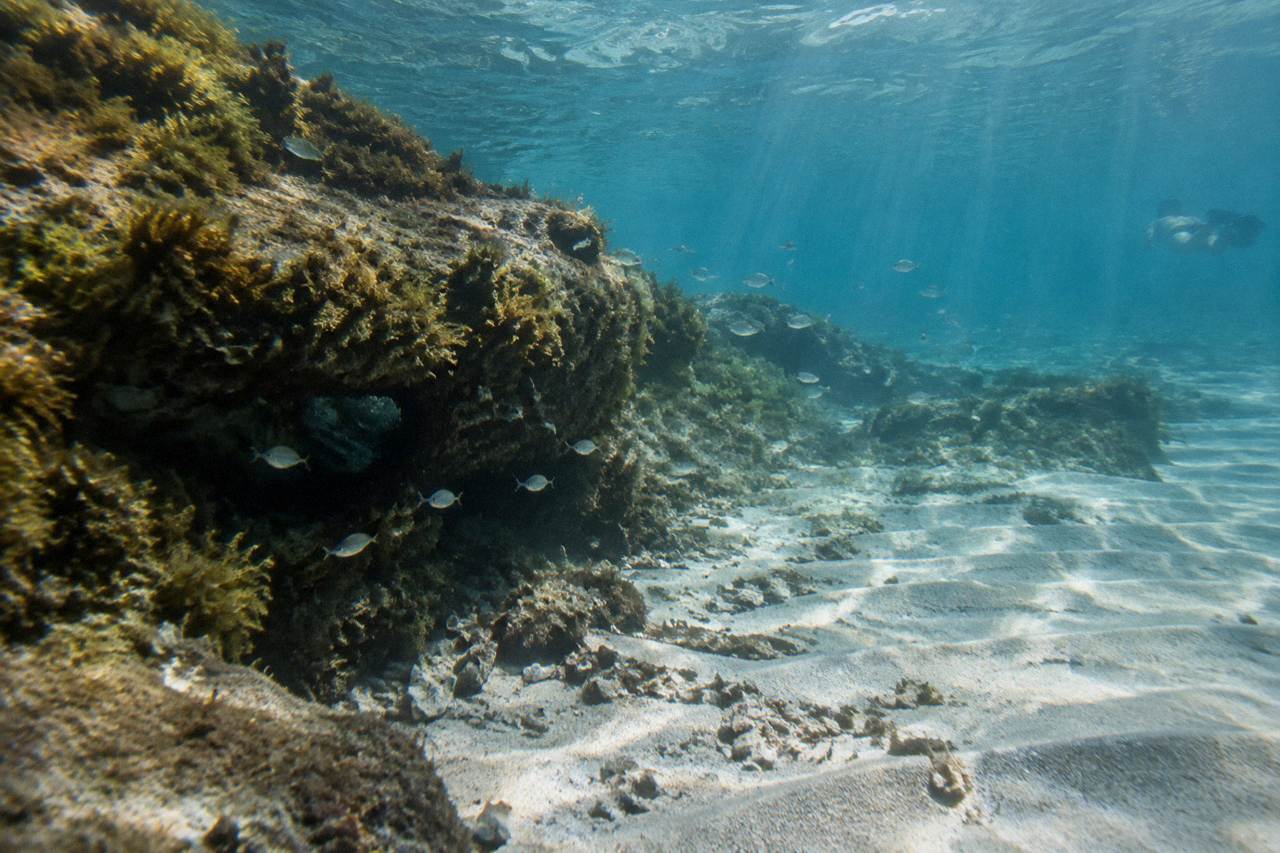
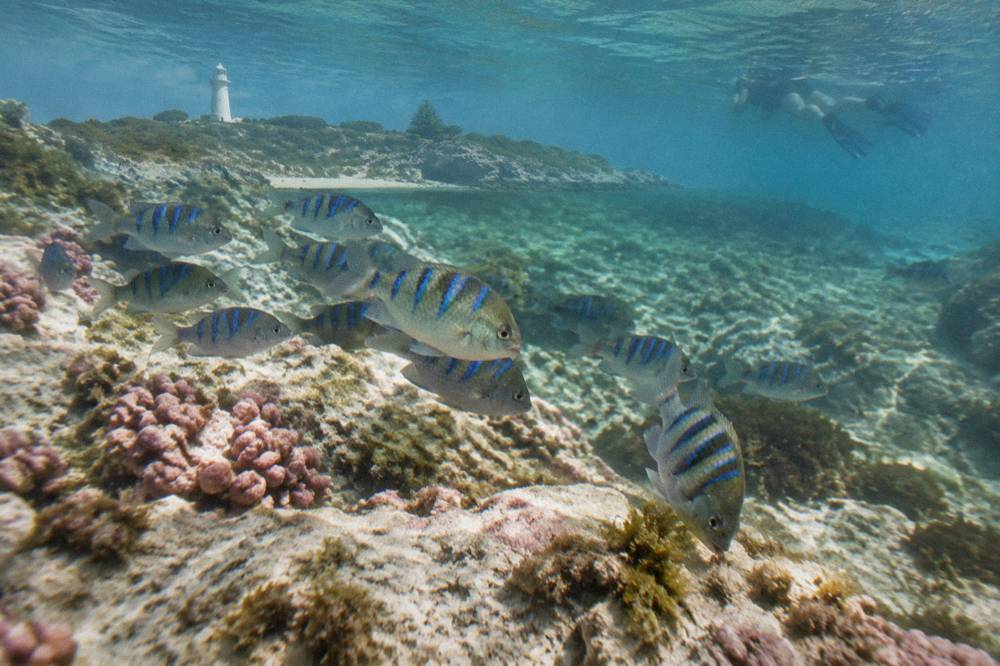
The fish list is the island's quiet superpower. Western king wrasse, buffalo bream, tarwhine, breaksea cod and bright schools of scalyfin patrol the limestone reef, and in the sanctuary zones, where no one has fished for years, the fish run larger and tamer than on the mainland coast. The sanctuary map is worth studying before you choose a bay: Kingston protects the shipwrecks of Thomson Bay, Parker Point the pink coral reef, Green Island the sea lion habitat, Armstrong Bay the seagrass meadows, and West End Demersal the deeper species including western rock lobster. The authority's sanctuary zones page spells out the boundaries and the rules.
Whales are the bonus nobody should book around. Between August and December, humpback and southern right whales migrate past the island, and ferry passengers occasionally spot them on the crossing itself, a free sighting no tour guarantees. Seals are a steadier bet: the Cathedral Rocks colony of long-nosed fur seals is resident, viewable from the platform on a bike ride out west. Ospreys nest on the rocky stacks near Salmon Point and Fish Hook Bay, and their dive-fishing is easy to watch from the water. If a full season-by-season breakdown helps your planning, the when can you see whales on Rottnest Island post has the detail.
| Marine life | Where | When | Guarantee |
|---|---|---|---|
| Tropical reef fish, 135+ species | Sanctuary zones, both trails | Year round | Near-certain in the zones |
| Long-nosed fur seals | Cathedral Rocks platform | Year round | Likely |
| Humpback and southern right whales | Offshore, sometimes from the ferry | August to December | No guarantee |
| Ospreys | Rocky stacks, Salmon Point area | Year round | No guarantee |
| Blue bottle jellyfish | Any bay, onshore winds | Variable | Treat all as possible |
What Should You Pack For A Snorkel Day?
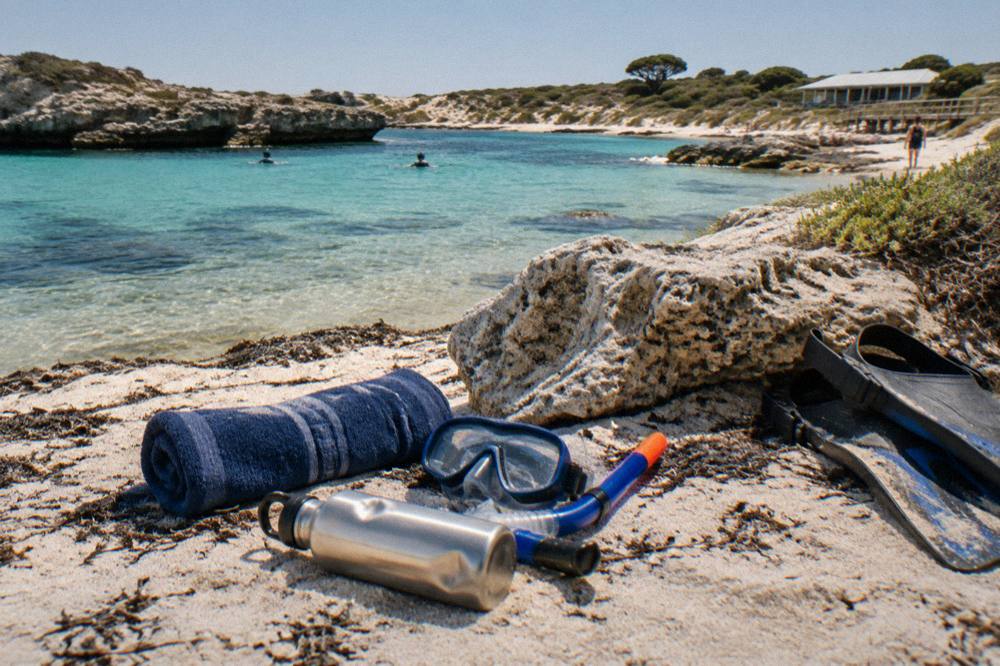
Pack a mask, snorkel and fins if you own them, reef shoes for the rocky entries, a rashie or short wetsuit for the shoulder months, at least two litres of water per person, reef-safe sun protection, and cash-free patience since the island runs on card. Tours supply gear; DIY snorkellers either bring it or hire from the island's bike and equipment operators with deposits payable.
The gear question splits along the guided line again. Both island tours include snorkel equipment in the fare, with the catamaran adding kayaks and paddleboards but not wetsuits or towels, so those visitors need only swimwear and a towel. Self-guided snorkellers face a choice: carry a mask set on the ferry, or hire on the island, where the main hire operator behind the Thomson Bay settlement stocks bikes, e-scooters and accessories with deposits on the standard fleet. Fins matter less than you would think at The Basin and more at Parker Point, where the plaques spread along the reef.
Practicalities are simple. Two General Stores, one at Thomson Bay and one at Geordie Bay, open seven days roughly 8 am to 6 pm and stock groceries, drinks and liquor, so lunch does not need to travel with you, though prices carry the freight cost of an island. There is an ATM at the Visitor Centre and lockers for bag storage there too. If your snorkel day is also a photography day, note that recreational drones are not permitted on the island at all, so the quokka selfie has to be handheld. Food options across the settlement are covered in what food is available on Rottnest Island, and the broader day-plan question, including whether four hours is enough, is answered in is 4 hours enough on Rottnest Island.
When Is The Best Time Of Year To Snorkel Here?
The best snorkelling months on Rottnest Island are the warm stretch from late spring through April, when the sea holds near its summer average of about 23 degrees and the afternoon sea breeze is at its most reliable, though the water stays swimmable year-round and the sanctuary zones hold fish in every season. Winter brings whales instead of warmth, and spring reopening dates apply to the seasonal boat tour operators.
The official rounded averages make the case better than adjectives. The Leeuwin Current keeps the sea near 23 degrees through summer and about 18 degrees across winter, a gentle range by southern-hemisphere standards. A 3 mm wetsuit makes the cooler water comfortable for most people, and the cooler months bring the added draw of daytime quokka activity, which rises outside the summer heat. What the cooler months take away is the seasonal tour coverage: the island's snorkel boat operators pause over winter and reopen in spring, so a guided trip in the cold half of the year may not exist on any given week.
Crowds follow the calendar closely. WA school holidays run 17 December 2026 to 31 January 2027, 10 to 25 April 2027 and 3 to 18 July 2027, and ferries plus the Island Explorer bus are known to book out in those windows, so early booking is the standing advice. The South32 Rottnest Channel Swim lands on Saturday 20 February 2027 and the free New Year's Eve family fireworks on Thursday 31 December 2026, both of which swell the island's population for a day. None of this is hostile to snorkelling; it just means the quiet-water hours at Parker Point are earlier, and the bike-hire queue is longer. Booking ahead, comparing options at Rottnest Tours, and travelling midweek where possible solves most of it.
Common Questions About Snorkelling On Rottnest Island
Where is the best snorkelling on Rottnest Island?
The Parker Point Snorkel Trail and the Little Salmon Bay trail, both inside the Parker Point marine sanctuary zone, are the signature sites. The Basin, a short walk from the settlement, is the best beginner option.
Can you snorkel at Rottnest without a tour?
Yes. A ferry and bike day from Hillarys starts at A$124 per person including the bike, helmet, lock and island admission, and both marked trails are reachable by bike or the Island Explorer bus.
How much does a guided snorkel tour cost on Rottnest?
The guided snorkel boat experience runs from A$239 per person for about three hours with gear included, and the half-day catamaran snorkel and sail from A$185 per person. Neither includes the ferry to the island.
Are Rottnest beaches patrolled by lifeguards?
No. The Rottnest Island Authority states that beaches are not patrolled by lifeguards, so swim with a friend, check conditions, and avoid the no-swim zones near the main and fuel jetties.
When can you see whales while snorkelling at Rottnest?
Whale season runs August to December, with humpback and southern right whales sometimes seen as early as June and July, usually from a boat or the ferry rather than while snorkelling. No tour guarantees a sighting.
How do you get to the Parker Point Snorkel Trail?
It is a 17-minute bike ride from Thomson Bay on the island's cycle paths, or stop 5 on the Island Explorer hop-on hop-off bus, which runs at roughly 15-minute intervals through the day.